
How to Use Jack Stands: The Procedure from OSHA, ASME PASE and the Makers
Affiliate disclosure: product links on this page go to Amazon, or to the maker's own store for brands that sell only direct. As an Amazon Associate we earn from qualifying purchases, at no extra cost to you; a link to a maker's store earns us nothing. No retailer or brand sees our picks before they are published or has any say in them. How we choose.
A jack lifts the car; a stand holds it. Every maker's manual says that in some form, OSHA says it for workplaces in 29 CFR 1910.244(a) ("After the load has been raised, it shall be cribbed, blocked, or otherwise secured at once"), and the ASME PASE standard, Safety Standard for Portable Automotive Service Equipment, is the American National Standard that covers jacks, automotive stands, ramps and mobile lifts, their marking, operation and inspection. This page gives the procedure as those sources state it, from parking the car to lowering it, with the figures from the makers in our floor jack and jack stand guides, and it ends with the 2020 recall of 1.7 million Harbor Freight stands, because that recall is the clearest statement on record of what a jack stand can do when its ratchet fails.
The rules, from the sources
| Rule | Source, as stated |
|---|---|
| The rated load is marked on the jack and must not be exceeded | OSHA 1910.244(a)(1)(ii): the rated load shall be legibly and permanently marked in a prominent location on the jack |
| Block the base on anything but a firm foundation; block between the cap and the load if the cap may slip | OSHA 1910.244(a)(2)(i) |
| Secure the load at once after raising it | OSHA 1910.244(a)(2)(iii): cribbed, blocked, or otherwise secured at once |
| Inspect jacks on a schedule: every 6 months in regular use, before and after any abnormal load or shock | OSHA 1910.244(a)(2)(vi) |
| Jacks, stands, ramps and mobile lifts: design, construction, marking, operation, maintenance and owner inspection | ASME PASE-2019 (scope, per ASME and ANSI's summaries); the 2024 update revised the scope and added requirements for automotive stands (Intertek's update notice) |
| Older stands and jacks may be labelled to the predecessor ANSI/PALD standard | Retailers' descriptions of Pro-Lift's T-6906D ("meets or exceeds ANSI/PALD"); PASE replaced PALD |
The procedure
As the manuals and OSHA's rule sequence it; read your jack's and stands' own manuals first, because their lift points, limits and lock types govern.
| Step | What | Why, and who says |
|---|---|---|
| 1. Ground | Level, hard, concrete; not asphalt in heat, not gravel, not a slope | OSHA: block the base in the absence of a firm foundation; a stand's base is small and a soft surface lets it tilt |
| 2. Park | Parking brake on, in park or in gear, wheels chocked on the end staying down | Makers' manuals; the car must not roll off the jack while it is on one point |
| 3. Lift point | The point the vehicle maker names in the owner's manual (pinch weld with an adapter, subframe, differential where the maker allows), never the floor pan, oil pan or suspension arm | Vehicle makers' manuals; ALI's Lifting Points guide for lifts covers the same points |
| 4. Jack | Jack rated above the corner's share of the vehicle, saddle square on the point, pumped until the stand fits under with room to set | OSHA: rated load marked; never exceed it |
| 5. Stand | Stand rated for the load, placed on a structural point beside the jack (frame rail, subframe, the maker's stand point), set to height, the pawl fully seated in a ratchet tooth, the pin locked on double-pin stands | Makers' manuals; the 2020 recall was a pawl that did not seat deep enough |
| 6. Lower onto the stand | Lower the jack slowly until the stand carries the load, watching the stand stay vertical; leave the jack in light contact as a backup if its maker allows | OSHA: secured at once; the stand holds, the jack lifts |
| 7. Shake test | Push the car at the lifted corner; if anything moves, lift and reset | Makers' manuals |
| 8. Pairs | Lift the other side the same way; a car on two stands sits level on points of the same height | Makers' manuals: stands in pairs |
| 9. Under the car | Only when the car is on stands and has passed the shake test; never on a jack alone, never on a bumper jack or a scissor jack from the trunk | OSHA; every maker's manual |
| 10. Down | Jack the corner just off the stand, remove the stand, lower slowly; other side the same | Makers' manuals |
Ratings
A jack's rating (3 tons, 6,000 pounds) is the whole jack's limit; a stand's rating is usually per pair in the makers' listings (Pro-Lift's T-6906D is 6 tons per pair by its spec table), so read whether a listing's figure is per stand or per pair. A corner of a 4,500-pound SUV is about a quarter of it with the car level and more when one end is lifted, which is why 3-ton stands are the floor for a car and 6-ton for a truck, and why the rating is not the place to economise. The Pro-Lift T-6906D's spec table gives a 16 to 23.5-inch range and a 10.5 by 8.875-inch base; low cars need a stand whose minimum height fits under the point, and tall trucks need the top of the range.
The 2020 recall
NHTSA's consumer advisory of May 28, 2020: Harbor Freight Tools recalled more than 1.7 million Pittsburgh Automotive 3-ton and 6-ton steel jack stands that may collapse under load, in two recalls, 20E016 (about 454,000 units made June 13, 2013 to November 22, 2019) and 20E027 (about 1,254,000 units made December 1, 2012 to March 31, 2020), item numbers 61196 and 56371 (3-ton) and 61197 (6-ton); the original manufacturer attributed the defect to the aging of production tooling; injuries were reported; owners were told to stop using them at once and were offered full refunds. The mechanism, as reported at the time, was ratchet teeth that did not engage the pawl deeply enough, so the stand could drop under load. Two things follow for every stand: the pawl must seat fully in a tooth every time (look, and listen for it), and a stand that has ever slipped is scrap. If you own Pittsburgh stands, check the item number on the label against the advisory. The recall checker searches all eleven jack stand recalls since 1990, including SKU 56373, the replacement 3-ton stand Harbor Freight recalled in July 2020.
Stands and the things sold instead of them
Ramps hold a car by its tires and are the ASME standard's other category; they work for oil changes and nothing that needs the wheels off. All-in-one bottle-jack-and-stand products (the 3-ton units in our guides) combine the lift and the hold in one column with a mechanical lock; they are a jack and a stand in one body and the maker's manual says how the lock is set before the hydraulic is released. A floor jack with a "safety lock" is still a jack. A QuickJack or scissor lift has mechanical locks the manual tells you to lower onto before going under, which is the same rule by another name.
Inspection
OSHA's schedule for jacks: every 6 months in constant or intermittent use at one place, and immediately before and after any abnormal load or shock. For stands the makers' manuals say to inspect before each use: cracks, bent legs, a pawl that does not spring back, a pin that does not pass, rust in the ratchet. A stand that has been dropped from a truck, run over or overloaded goes in the bin; it is $40 and the alternative is on the NHTSA page.
What this page is not
A substitute for your vehicle's and your jack's manuals, which name the lift points and limits, or a workplace program, which OSHA's rule assumes. It is the procedure every source we read agrees on, in one place, for a home garage.
Frequently asked questions
Can I get under a car that is only on a floor jack?
No. OSHA 1910.244(a) requires a raised load to be cribbed, blocked or otherwise secured at once, and every maker's manual says the jack lifts and the stand holds. Get under only when the car is on stands and has passed a shake test.
Where do jack stands go on a car?
On the structural points the vehicle maker names: frame rails, subframe, the pinch weld with an adapter, or where the owner's manual shows. Never on the floor pan, oil pan or a suspension arm. ALI's Lifting Points guide covers the same points for lifts.
What capacity jack stands do I need?
Above the share of the vehicle the stands will carry, with the listing's figure read as per pair where the maker states it (Pro-Lift's T-6906D is 6 tons per pair). 3-ton stands are the floor for a car and 6-ton for a truck or SUV.
Which jack stands were recalled?
NHTSA's May 28, 2020 advisory: Harbor Freight's Pittsburgh Automotive 3-ton stands, item numbers 61196 and 56371, and 6-ton stands, item number 61197, more than 1.7 million units made between December 2012 and March 2020, which may collapse under load. Owners were told to stop using them and offered refunds.
What is ASME PASE?
ASME PASE, Safety Standard for Portable Automotive Service Equipment, is the American National Standard covering hydraulic and mechanical jacks, automotive stands, ramps and mobile lifts: design, construction, marking, operation, maintenance and inspection. It replaced ANSI/PALD, which older stands may still cite.
Should I leave the jack under the car as a backup?
Many makers' manuals allow the jack to stay in light contact after the stand carries the load, as a second support. The stand carries the car; the jack is never the only thing under it.
Sources
- 29 CFR 1910.244 Other portable tools and equipment (jacks), Occupational Safety and Health Administration
- ASME PASE-2019: Safety Standard for Portable Automotive Service Equipment, ASME via the ANSI Webstore
- ASME PASE-2019: Portable Automotive Equipment (summary), ANSI Blog
- ASME PASE Standards Update Notice (June 1, 2024), Intertek
- Consumer Advisory: Warning to Harbor Freight Jack Stand Users (May 28, 2020), National Highway Traffic Safety Administration
- Pro-Lift jack stand specification sheet (T-6906D), Pro-Lift (via The Home Depot)
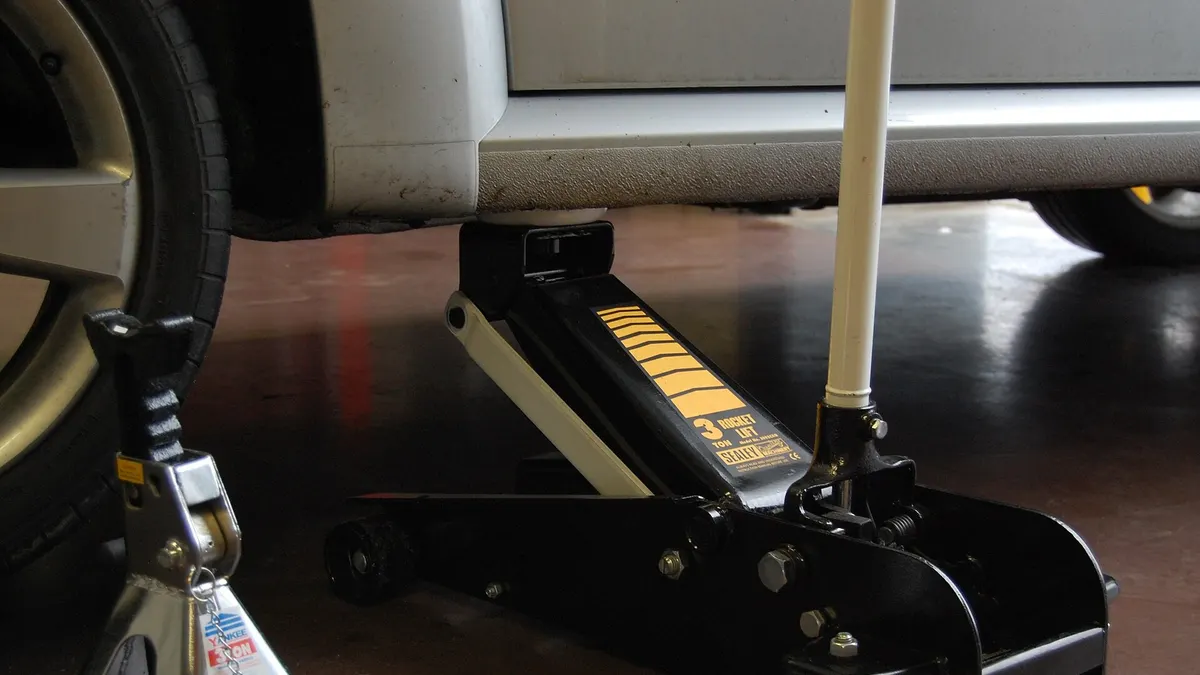
Cover photo: Sealey hydraulic jack and jack stand by Mark Hunter, CC BY 2.0, via Wikimedia Commons. Cropped.
Related guides
ALI Certified Car Lifts Explained: What the Gold Label Covers, How to Check
ALI certification from the Automotive Lift Institute's own pages: the standard, the Gold Label, the directory, the marks that do not count, and the home lifts that claim it.

Car Lift Ceiling Height and Concrete Guide: What the Manuals Require
The slab, anchor and ceiling rules from BendPak, MaxJax and Atlas manuals, the overall height of each lift we cover, and the measurements to take before buying.
Car Lift Installation Guide: What the Manuals Say Happens Before the First Lift
The installation sequence from the BendPak and MaxJax manuals: site, delivery, assembly, anchors, electrician, fluid, first test lift and the inspections that follow.