
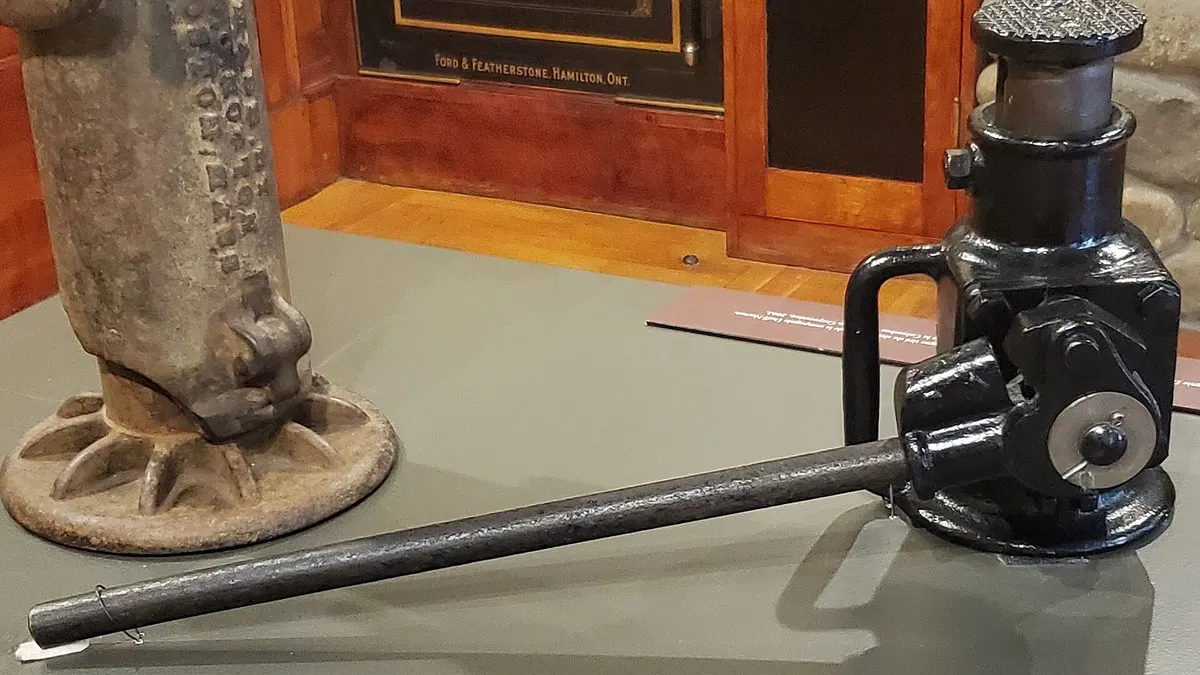
Floor Jack vs Bottle Jack vs Scissor Jack: Which Lifts What, and Why None Holds
Affiliate disclosure: product links on this page go to Amazon, or to the maker's own store for brands that sell only direct. As an Amazon Associate we earn from qualifying purchases, at no extra cost to you; a link to a maker's store earns us nothing. No retailer or brand sees our picks before they are published or has any say in them. How we choose.
Three jacks lift a car and none of them holds it. OSHA's rule for jacks, 29 CFR 1910.244(a), says the rated load is marked on the jack, the base is blocked where the ground is not firm, a block goes between the cap and the load if the cap may slip, and after the load has been raised it shall be cribbed, blocked or otherwise secured at once; the ASME PASE standard covers all three types and the stands that do the holding. Within that rule the three differ in how they lift: a floor jack rolls its saddle under a lift point on a long chassis and pumps a lever; a bottle jack stands its ram under the point and pumps a short handle; a scissor jack winds a screw. This comparison puts the makers' figures for each side by side, from the floor jack guide, Powerbuilt's bottle-jack-and-stand and the trunk scissor jacks on Amazon, and says where each belongs.
The three, side by side
| Floor jack | Bottle jack | Scissor jack | |
|---|---|---|---|
| How it lifts | Hydraulic ram on a rolling chassis, lever pumped; saddle rises on an arm | Vertical hydraulic ram in a bottle-shaped body, short handle pumped | Screw thread drives a diamond-shaped scissor, turned by a handle or lug wrench |
| Capacity seen | 2 to 3 tons (DNA Motoring 2 ton; SUNEX 6602LP 2 ton; Jack Boss, Maxority, AV Steel, VEVOR, LARBANKE 3 ton; Daytona 3 and 4 ton) | 3 tons on the Powerbuilt all-in-one (6,000 lb; one bullet says 3,000); larger bottle jacks reach 12, 20 and 50 tons | 2 to 2.5 tons on the trunk kits (4,409 lb and 5,000 lb by their listings) |
| Minimum height seen | 2.75 in (SUNEX) to 5.5 in (AV Steel 3 ton) | 11 in (Powerbuilt); most bottle jacks 7 to 9 in | About 4 in on trunk kits |
| Maximum height seen | 13 in (DNA Motoring) to 24.25 in (Daytona long reach) | 21 in (Powerbuilt) | About 15 to 16 in on trunk kits |
| Saddle | Large round pad, 360-degree rotation on most | Small ram cap, about 2 in | Small slotted cradle for a pinch weld |
| Base | Long chassis on four wheels; stable | Small; Powerbuilt's wide base is the exception by design | Small flat plate |
| Speed | Dual-piston jacks: 3.5 pumps (Harbor Freight's Daytona manual) to 6.5 (SUNEX) | Many short strokes | Many turns of the screw |
| Weight | 63.8 lb (AV Steel stated) to about 77 lb (Daytona 3 ton, Harbor Freight) | A few pounds to 20 | Under 10 lb |
| Price seen | $46 to $378 | $98 to $100 (Powerbuilt all-in-one) | $26 to $40 (trunk kits) |
| Belongs | The garage floor | Trucks, frames, RVs, levelling, tight spaces with firm ground | The trunk, for a roadside wheel change |
Floor jack
The garage jack. Its chassis reaches a subframe behind a bumper (SUNEX states 18 inches of throw), its saddle is large enough to sit square on a frame rail or a pinch-weld adapter, its four wheels follow the car's arc as it rises, and its range (the Daytona long reach: 3.25 to 24.25 inches by Harbor Freight) covers a lowered car and a truck. It is heavy and it takes floor space; those are the only arguments against it. The floor jack guide ranks eleven of them.
Bottle jack
The ram jack. It lifts more per pound of jack than anything else, which is why 12 and 20-ton bottle jacks exist, and it fits where a floor jack's chassis will not. Its weakness is the base and the cap: a small footprint that tips on anything but firm, level ground, and a small cap that OSHA's rule says to block if it may slip. It wants a frame rail or a solid axle under a truck, and it is the wrong jack for a car's pinch weld. Powerbuilt's all-in-one, a 3-ton bottle jack with a ratcheting stand built into its column, 11 to 21 inches on a wide base, is sold for trucks, RVs and trailers by its listing; it lifts and holds, which makes it the one jack here that OSHA's "secured at once" is built into, and it is still a single column under one point.
Scissor jack
The trunk jack. A 2-ton scissor kit with a lug wrench is $26 to $33 on Amazon (the Beaiguna and unbranded kits list 4,409 pounds; a 2.5-ton kit lists 5,000), and the one the car came with is the same thing. It lifts one corner for a wheel change on the shoulder, slowly, on a small plate, and the listings say so. It is not garage equipment: no range for a drooped wheel, no saddle for a frame rail, no stability for a car with the wheels off and a person under it. The makers' manuals for cars say to use it only for the spare.
The rule they share
OSHA 1910.244(a)(2)(iii): after the load has been raised, it shall be cribbed, blocked, or otherwise secured at once. Every floor jack listing we read says it in its own way (DNA Motoring: the jack must not be used as a jack stand to hold a load for any period), and the jack stand guide is the procedure. The stands are the purchase that goes with any of the three.
Which to own
A garage owns a floor jack and a pair of stands. A truck owner adds a bottle jack for the frame and the field, or buys the Powerbuilt that holds as well. A car keeps its scissor jack in the trunk for the roadside and nowhere else. The buying guide puts the jack and stands first on the list for the reason above.
Frequently asked questions
Is a bottle jack or a floor jack better?
A floor jack for the garage: long reach, a large saddle, four wheels and a 3 to 24-inch range on the best (Daytona long reach). A bottle jack for trucks, frames and tight spaces on firm ground: more lift per pound, a small base and cap. Neither holds a car; stands do.
Can I use a scissor jack to work under a car?
No. A trunk scissor jack lifts one corner for a wheel change on a small plate, slowly; the car makers' manuals limit it to the spare. OSHA's rule requires a raised load to be secured at once, on stands.
How high does a bottle jack lift?
Powerbuilt's 3-ton all-in-one runs 11 to 21 inches by its listing; most bottle jacks start at 7 to 9 inches. The height depends on the ram stroke, which is why bottle jacks suit trucks and not low cars.
What is a bottle jack with a built-in stand?
Powerbuilt's all-in-one: a 3-ton bottle jack whose column carries a ratcheting safety bar that locks the raised height, 11 to 21 inches on a wide base, for trucks, RVs and trailers by its listing. It is one column under one point, not a pair of stands.
Which jack is fastest?
A dual-piston floor jack: Harbor Freight's Daytona manual says about 3.5 pumps, SUNEX's 6602LP 6.5. A bottle jack takes many short strokes and a scissor jack many turns.
Do all three jacks fall under the same standard?
ASME PASE, the Safety Standard for Portable Automotive Service Equipment, covers hydraulic and mechanical jacks and automotive stands; OSHA 1910.244(a) applies to jacks in workplaces. VEVOR's floor jack listings cite ASME PALD-2014, the standard's earlier name.
Sources
- 29 CFR 1910.244 Other portable tools and equipment (jacks), Occupational Safety and Health Administration
- ASME PASE-2019: Safety Standard for Portable Automotive Service Equipment, ASME via the ANSI Webstore
- Daytona 3 Ton Long-Reach Low-Profile Professional Floor Jack (item 64781), Harbor Freight Tools
- Harbor Freight expands Daytona lineup of floor jacks (press release), Vehicle Service Pros (Harbor Freight release)
Cover photo: Musée Beaulne - cric -3 by Cantons-de-l'Est, CC0 1.0, via Wikimedia Commons. Cropped.
Related guides
Best Engine Hoists (2026): 2-Ton Cherry Pickers by Boom Rating, Legs and Folding
Seven hoists and five levelers, with the four boom ratings every 2-ton hoist carries, leg clearance, folding, casters and the engine weights the makers publish.
Best Engine Stands (2026): 750 to 2,000 lb, by Capacity, Casters and Folding
Six engine stands from $72 to $190: capacity, rotating head, mounting arms, casters, folded width, and the maker engine weights to size them against.
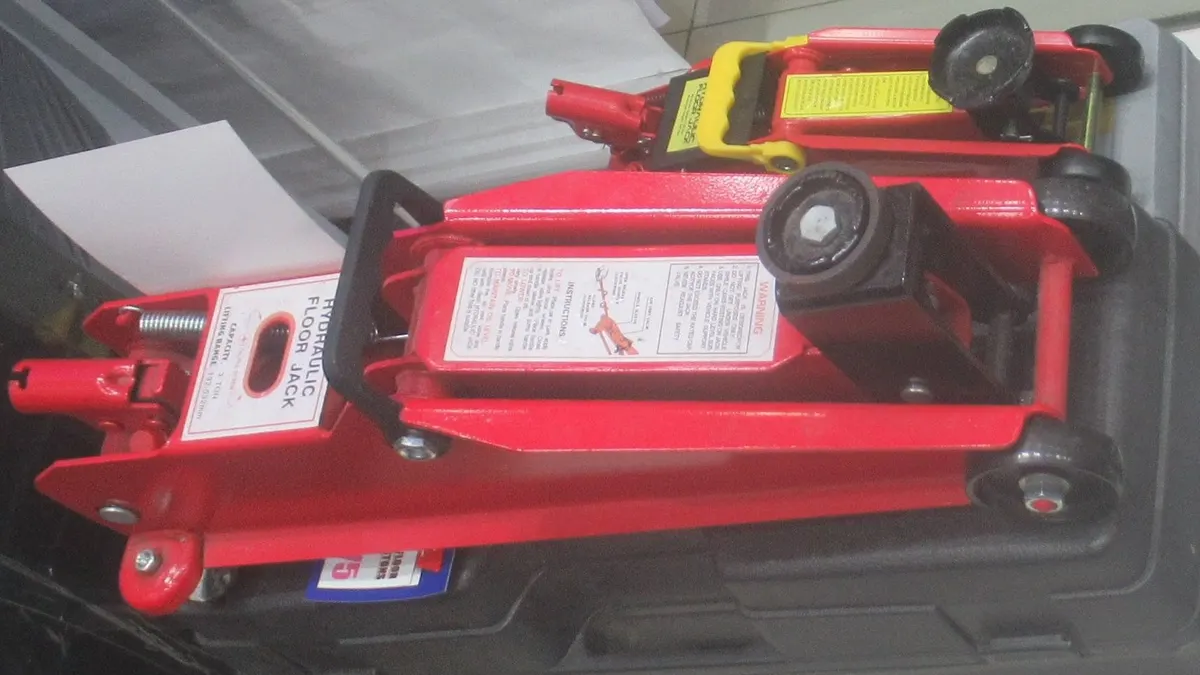
Best Floor Jacks (2026): 2 to 3 Ton, by Lift Range, Saddle Height and Standard
Ten floor jacks from $46 to $378, each with capacity, minimum and maximum saddle height, weight and whether its listing claims ASME PASE or PALD.