
2-Post vs 4-Post Car Lift for a Home Garage: Ceiling, Slab, Space and the Work
Affiliate disclosure: product links on this page go to Amazon, or to the maker's own store for brands that sell only direct. As an Amazon Associate we earn from qualifying purchases, at no extra cost to you; a link to a maker's store earns us nothing. No retailer or brand sees our picks before they are published or has any say in them. How we choose.
A two-post lift holds the car by its frame with the wheels hanging free; a four-post lift holds it by its wheels on two runways. Everything else follows from that: what work you can do under it, what the floor and ceiling have to be, whether it anchors, whether it stores a second car, and what it costs. This comparison uses the makers' published figures for the lifts in our guides, the BendPak 10AP, 9APF and HD-9 from bendpak.com and the Atlas 9KOHX and Garage Pro 8000 from a dealer's listings, and the makers' manuals for the slab and electrical rules. It does not say either is safer; ALI certification is the only third-party test, and the ALI page lists which models state it and which are in ALI's directory.
The two designs
Two-post: two columns anchored to the slab, four swing arms with pads that meet the vehicle's frame lift points, the wheels in the air. Overhead (clear-floor) models join the columns with a beam that carries the hydraulic line and a shutoff bar (the 10AP's is at 139.5 inches); floorplate (baseplate) models run the line across the floor in a plate and keep the overall height lower (the 9APF is 123 inches against the 10AP's 145). Four-post: four columns with two runways between them, the vehicle driven on and lifted on its wheels; the runways carry a sliding jack tray for a bridge jack when the wheels need to come off; the lift is freestanding (BendPak's description of the HD-9) and takes a caster kit, which is why the Atlas is sold as portable.
The figures
| BendPak 10AP (2-post) | BendPak 9APF (2-post, low ceiling) | Atlas 9KOHX (2-post) | BendPak HD-9 (4-post) | Atlas Garage Pro 8000 (4-post) | |
|---|---|---|---|---|---|
| Capacity | 10,000 lb | 9,000 lb | 9,000 lb | 9,000 lb | 8,000 lb |
| Overall height | 145 in | 123 in | 138 or 142 in | 88 in | 83 in (columns) |
| Rise | 69 in; 82.5 max with pad | 70 in; 73.5 with pad | 74 in; 81 with adapters | 70 in; 75 max lifting height | 72 in to top of runway; 67 under |
| Min pad or runway height | 4 in | 4.5 in | 4 in | 5 in runway (4.5 in description) | Runway 4.5 in thick |
| Width | 135 to 145 in | 136 to 146 in | 134.5 in | 110.25 in | 115 in with motor |
| Length | Column footprint | Column footprint plus floor plate | Column footprint | 200.5 in overall (174 outside) | 206.75 in with ramp |
| Anchored | Yes; 4.25 in, 3,000 PSI, 28-day slab (manual) | Yes (BendPak concrete page) | Yes; 4 in, 3,000 PSI (dealer) | Freestanding (page); caster kit optional | Freestanding; casters included (dealer) |
| Power | 208-240 V, 1 Ph, 3 HP, about 11 A (manual) | 208-230 V, 1 Ph, 5 HP | 220 V, 1 Ph; dealer recommends a 30 A breaker | 208-230 V, 1 Ph, 2 HP | 110 V; dealer says a 30 A breaker |
| ALI certification | Named on the product page; in ALI's directory | Not stated; not in ALI's directory | Dealer: none claimed; not in ALI's directory | Not stated in the text, but in ALI's directory | Dealer: none claimed; not in ALI's directory |
| Shipping weight | 1,768 lb | Not read | Not read | 1,616 lb | 1,800 lb |
| Price (Oct 9, 2026) | $6,095 | $6,295 | $2,599 (dealer) | $6,095 | $3,399 (dealer) |
Ceiling
A four-post wins on the columns: 83 to 88 inches of lift against 123 to 145 for the two-posts. But a four-post lifts the car on its wheels, so the car's full height rides up with it; the 10AP lifts by the frame and the car's roof is at the same height as on a four-post at the same rise. The arithmetic is the same (the calculator): roof height plus rise plus margin under the ceiling. The real difference is whether the lift itself fits: a 145-inch 10AP needs a 12-foot-plus ceiling for the columns before the roof is considered; an 88-inch HD-9 fits under 8 feet and then lifts a 60-inch car about 30 inches. The 9APF exists for the 10-foot ceiling. The ceiling and concrete guide has every height.
Slab and anchors
The two-post is anchored and the slab is the requirement: BendPak's 10AP manual says steel-reinforced, 4.25 inches, 3,000 PSI, cured 28 days, anchors more than 6 inches from joints and walls; Atlas's dealer says 4 inches at 3,000 PSI; the MaxJax manual bans drilling post-tensioned slabs. A nominal 4-inch residential slab is at or under those figures and BendPak says to test drill. The four-posts are freestanding: no drilling, which is the whole case for them on an unknown slab, on a rental, or on a floor you may want back.
The work
Two-post: wheels, brakes, suspension, exhaust, transmission, everything under the car with the wheels off, because the wheels hang free and nothing is in the way of the underside except the arms. Four-post: oil changes, exhaust, inspection, undercoating and storage with the wheels on the runways; wheels-off work needs a bridge jack on the runways (the Garage Pro 8000 ships a jack tray, BendPak sells rolling jacks for the HD-9), which lifts the car a second time off the runways. A home mechanic who pulls wheels every weekend wants the two-post; one who stores a second car and does oil changes wants the four-post.
Storage
The four-post parks a car in the air with another under it, in a 200-inch-long footprint: the HD-9's 174-inch outside length and the Garage Pro's 206.75 with ramp are the depth of a bay. A two-post cannot store a car in the air for long without a reason; the makers' manuals cover leaving a vehicle on the locks, and the arms are not a parking space. If the question is "two cars in one bay", it is a four-post question.
Space and portability
Two-post: 134 to 146 inches of width at the columns, a column footprint in length, and the full bay width lost to the doors opening between the columns. Four-post: 110 to 115 inches wide, 200-plus long, and the car is driven on, so the bay's length matters more than its width. The four-post rolls on casters (HD-9 optional, Garage Pro included) to clear a bay; the two-post is a fixture once anchored, which is what the MaxJax and QuickJack were designed to answer.
Price
At BendPak, a two-post and a four-post of the same class cost the same ($6,095 for the 10AP and the HD-9). At Atlas, through a dealer, the two-post is $2,599 and the four-post $3,399. Installation is extra for either and is more for the anchored two-post; the electrician is required for both (the electrical guide); a bridge jack for a four-post is a separate line.
Which to buy
Two-post if: the ceiling clears the columns, the slab passes (test drilled, not assumed), the work is wheels-off, and the bay is wide. Four-post if: the slab is unknown, post-tensioned or thin; the garage is a rental or the floor may be wanted back; a second car needs storing; the ceiling is low; or the work is oil changes and exhaust. Neither if the ceiling is 8 feet and the slab is 4 inches and the budget is $3,000: that garage is the portable lift or scissor lift garage. The two-post guide and four-post guide rank the models.
Frequently asked questions
Which needs less ceiling height, a 2-post or a 4-post lift?
The four-post's columns are shorter (BendPak HD-9 88 inches, Atlas Garage Pro 8000 83 inches) against 123 to 145 for the two-posts, so the lift fits under a lower ceiling. The car's roof at a given rise is at the same height on either; the calculator runs both checks.
Does a 4-post lift need to be bolted down?
BendPak calls the HD-9 a freestanding design and sells a caster kit; the Atlas Garage Pro 8000 ships with casters by its dealer. Two-post lifts are anchored, with the slab requirements in their manuals (BendPak 10AP: 4.25 inches, 3,000 PSI, 28 days).
Can I take the wheels off on a 4-post lift?
Only with a bridge jack rolling on the runways, which lifts the car off them a second time. A two-post holds the car by the frame with the wheels free, which is why it is the wheels-off lift.
Which is better for storing a second car?
The four-post: the car parks on the runways with another beneath, in a footprint about 200 inches long (HD-9 200.5 overall; Garage Pro 8000 206.75 with ramp). A two-post's arms are not a parking space.
Is a 2-post or a 4-post lift cheaper?
At BendPak they cost the same (10AP and HD-9 both $6,095 on October 9, 2026); at Atlas through a dealer the two-post is $2,599 and the four-post $3,399. Installation of an anchored two-post costs more; both need an electrician.
Which is ALI certified?
ALI's directory lists both of the BendPaks that matter here, the 10AP two-post and the HD-9 four-post, although only the 10AP's page says so. It lists neither the BendPak 9APF nor the Atlas 9KOHX or Garage Pro 8000, for which the Atlas dealer says no third-party listing is claimed (directory searched October 12, 2026).
Sources
- BendPak 10AP Two-Post Lift (product page), BendPak
- BendPak 9APF Low-Ceiling Floorplate Two-Post Lift (product page), BendPak
- BendPak HD-9 Four-Post Lift (product page), BendPak
- BendPak 10AP Installation and Operation Manual, BendPak
- MaxJax M7K Installation and Operation Manual, MaxJax
- Atlas 9KOHX (dealer listing), Mechanic Superstore
- Atlas Garage Pro 8000 (dealer listing), Mechanic Superstore
- Lift Certification FAQ, Automotive Lift Institute
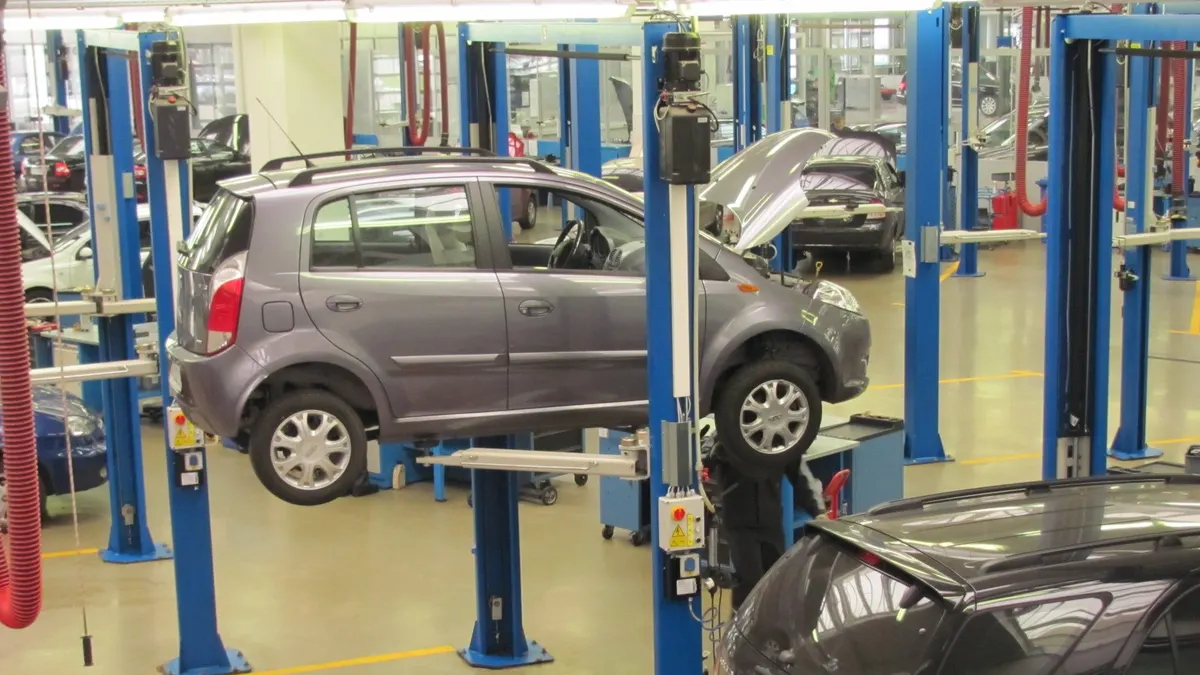
Cover photo: Chery A1 - service shop in Ukraine (7) by ANT Berezhnyi, CC BY 3.0, via Wikimedia Commons. Cropped.
Related guides
BendPak vs QuickJack vs MaxJax vs Atlas: Four Lift Makers on What They Publish
Four names on every lift page, compared on published specs, manuals, concrete and power rules, ALI statements, warranty and price. Two of them are the same company.
Best 2-Post Car Lifts for a Home Garage (2026): By Ceiling, Slab and Maker
Eight two-post lifts from $1,989 to $6,295, each with its column height, rise, slab and power requirements and what the maker says about ALI certification.
Best 4-Post Car Lifts for a Home Garage (2026): Storage, Service and What Fits
Nine four-post lifts from $2,888 to $6,095, with column height, runway and overall length, power and the caster kits, ramps and jack trays that come in the box.